
Calculating a sterling piece’s melt value is genuinely straightforward math once you know the formula — but the number that trips people up isn’t the math itself, it’s the intuition. A single teaspoon’s melt value looks small enough to dismiss. A full canteen’s aggregate weight tells a very different story. Both are true at once, and understanding why is most of what you need to know before selling or scrapping anything sterling.
The Basic Formula
Melt value equals a piece’s silver weight, multiplied by 0.925 to account for sterling’s 92.5% purity, multiplied by the current silver spot price per troy ounce. Three numbers multiplied together — and the purity factor is the one readers most consistently get wrong, either forgetting it entirely or applying it to the wrong figure. Spot price is quoted per troy ounce of pure (.999) silver. Sterling is only 92.5% silver, so skipping that 0.925 multiplier overstates value by nearly 8% on every single piece.
Troy Ounces vs. Standard Ounces
Precious metals are priced in troy ounces, which are heavier than the standard avoirdupois ounces used for everyday weight — roughly 31.1 grams versus about 28.35 grams. Using a standard kitchen scale that measures in regular ounces without converting to troy ounces produces a genuinely incorrect melt value, so getting this conversion right matters more than it might seem.
A Worked Example: Individual Pieces
Real flatware weights vary by form. A sterling teaspoon typically runs roughly 20–30 grams; a sterling dinner fork typically runs roughly 50–60 grams. Using 25g and 55g as representative weights, and $66 per troy ounce as an illustrative spot price (check a live spot price source for today’s actual number before you calculate anything real):
- Teaspoon (25g): 25g × 0.925 = 23.13g pure silver → 23.13 ÷ 31.1035 = 0.743 troy oz → 0.743 × $66 ≈ $49
- Dinner fork (55g): 55g × 0.925 = 50.88g pure silver → 50.88 ÷ 31.1035 = 1.636 troy oz → 1.636 × $66 ≈ $108
Looked at one piece at a time, this is exactly why melt value feels deceptively small — a teaspoon melting down to roughly $49 doesn’t sound like much. But almost nobody sells a single teaspoon. They sell a set.
A Worked Example: A Full Canteen
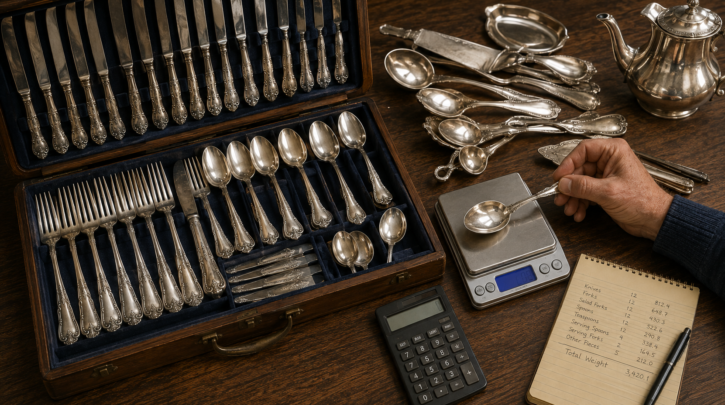
Take a service for 12 with four pieces per setting — 12 teaspoons, 12 dinner forks, 12 salad forks, and 12 soup spoons, using representative weights of 25g, 55g, 35g, and 45g respectively. That’s 48 pieces totaling 1,920 grams of sterling.
1,920g × 0.925 = 1,776g pure silver → 1,776 ÷ 31.1035 = 57.1 troy oz → 57.1 × $66 ≈ $3,769.
The aggregate weight of a full canteen is where the real number shows up — nearly $3,800 in this example, before any dealer margin, from pieces that each looked unremarkable on their own. That’s also exactly why per-piece melt value and per-set collector value rarely match: a genuinely rare or discontinued pattern in complete condition can be worth several multiples of even this aggregate melt figure to the right collector, because completeness itself carries a premium melt math doesn’t capture at all. See our set completeness guide for how that premium gets calculated.
Weighing Accurately
A scale precise enough to measure in grams or troy ounces, rather than a general household scale, gives the accuracy needed for a meaningful melt value calculation — if your scale only reads in grams, divide the total by 31.1035 to convert to troy ounces before applying the rest of the formula.
Knife Blades Aren’t Silver
Because knife blades are typically stainless steel rather than sterling, weighing a whole knife and treating its full weight as silver content significantly overstates its melt value — either weighing just the handle separately, where feasible, or using a documented approximate sterling content figure for that specific piece type gives a more accurate result. This is exactly the kind of piece-type variation that makes a flat per-piece average misleading across a mixed set; see our identification guide for why knife construction works this way.
Checking Current Spot Price
Silver spot price genuinely fluctuates daily along with broader commodity markets, so checking a live, current source before calculating melt value gives a far more accurate figure than relying on a remembered price from even a few weeks earlier — the $66 figure used in the examples above is a snapshot, not a constant.
Dealers Pay Below Full Spot-Price Value
Precious metal dealers and refiners typically pay somewhat below the full calculated melt value, reflecting their own business margin and refining costs — worth setting realistic expectations rather than assuming a dealer will pay the exact calculated figure. That $3,769 canteen example above is a ceiling, not a guaranteed offer.
Where to Sell for Melt Value
Local coin and precious metal dealers, along with dedicated refiners, are the standard channels for selling sterling specifically for its melt value, distinct from the collector and pattern-focused buyers who purchase flatware intact. See our melt vs. sell guide for how to decide which path actually makes more sense for a specific piece or set.
Getting Multiple Quotes
Melt value offers can vary somewhat between different dealers depending on their specific margin and current buying practices, so getting quotes from more than one buyer before committing to a sale helps confirm you’re getting a genuinely fair price rather than the first offer that happens to come along.
Weighing Before You Commit to Selling
Doing your own weight-based melt value calculation before approaching a dealer gives you a realistic expectation going into the conversation, making it much easier to recognize whether an offered price is reasonably close to fair or noticeably below what the math actually supports.
Silver Content Varies Slightly by Piece Type
Different flatware forms carry different silver weights even within the same pattern — a serving spoon naturally contains more silver than a teaspoon, and hollow-handle pieces contain proportionally less silver relative to their overall size than solid pieces do. This is exactly why the canteen example above weighed each piece type separately rather than applying one average across all 48 pieces — that piece-by-piece precision matters more the larger and more mixed a set is.