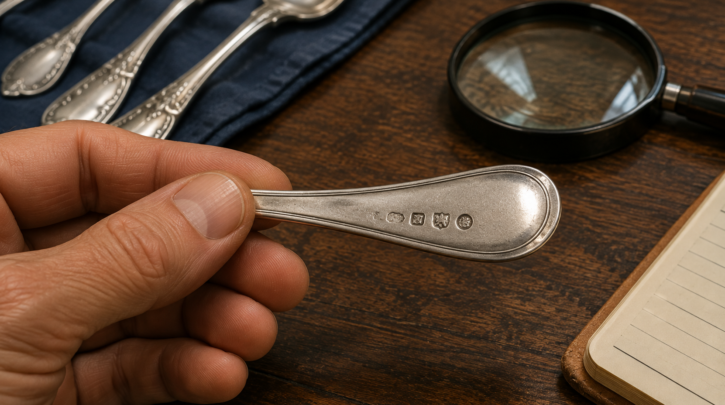

Before you spend money on a flatware appraisal, spend five minutes on the hallmark. It’s stamped on the back of the handle, and it tells you almost everything you need to know about whether a paid appraisal is even the right move — because sterling and silverplate aren’t just different quality tiers, they’re different value categories entirely.
Step One: Read the Hallmark (This Part Is Free)
Flip a piece over and look at the back of the handle, near the base of the bowl or tines. What’s stamped there sorts your flatware into one of two very different value categories before you’ve spent a dime.
- STERLING or 925 — solid silver, roughly 92.5% pure. This has real melt value tied to the current spot price of silver, on top of whatever collector value the pattern carries.
- EPNS, EP, EPBM, A1, or “quadruple plate” — electroplated. A thin layer of silver over a base metal core (usually nickel or copper alloy). The melt value here is negligible; there’s simply not enough actual silver to matter.
- No visible mark, or a worn/illegible stamp — common on older or heavily polished pieces. Our marks and hallmarks guide walks through magnet tests and other ways to narrow it down, and our sterling vs. silverplate guide covers the visual and weight differences if the stamp isn’t cooperating.
This one check reframes the whole appraisal decision. It’s not really “should I get an appraisal” — it’s “what kind of value am I even appraising?”
Why Plated Pieces Rarely Justify a Paid Appraisal
If the hallmark says EPNS, EP, EPBM, A1, or quadruple plate, a paid appraisal is usually money spent for very little new information. There’s no meaningful melt value to document, so whatever value the piece has is entirely pattern- and maker-driven — and that’s research you can largely do yourself for free, using pattern ID resources and completed marketplace sales, rather than paying an appraiser’s flat fee or hourly rate to tell you the same thing.
That’s not to say plated flatware is worthless — a discontinued pattern from a name-brand maker can still carry real collector interest. It just means the appraisal itself, as a paid professional service, rarely pays for itself here. See our flatware value guide and pattern identification guide for the self-research route.
Where Sterling Still Doesn’t Need a Paid Appraisal
Not every sterling piece needs a professional either. A common, still-in-production pattern, a single place setting, or pieces in heavily worn condition tend to have straightforward value you can estimate from recent completed sales or a knowledgeable dealer’s informal opinion — a formal appraisal is more documentation than the situation calls for.
Where a Paid Appraisal Actually Pays for Itself
A paid, formal appraisal earns its cost in a narrower set of situations — and with sterling, these are the ones worth watching for:
- Rare or discontinued patterns. These can carry significant collector premiums over melt value that only a specialist familiar with the pattern market would catch. Check our most valuable sterling patterns guide for a sense of what “rare” looks like in practice.
- Complete canteens. A full set — every place setting plus serving pieces — is worth substantially more intact than the sum of its individual pieces, and that premium is easy to underestimate without professional eyes. Our set completeness guide explains what “complete” actually means for a canteen.
- Insurance or estate settlement. These require documented, professional valuation regardless of pattern rarity — an informal estimate won’t satisfy either requirement.
And regardless of plate or sterling: never melt anything until you’ve ruled out a rare pattern or a complete set. Our melt vs. sell guide covers why that sequencing matters.
Finding a Qualified Appraiser
Once you’ve decided a paid appraisal makes sense, look for someone experienced specifically with silver flatware rather than a general antiques appraiser — the collector side of this hobby has its own quirks that a generalist can miss. Check for credentials from a recognized body: the International Society of Appraisers, the Appraisers Association of America, and the American Society of Appraisers all certify appraisers to established professional standards.
A Red Flag Worth Knowing
Reputable appraisers charge a flat fee or an hourly rate — never a percentage of the appraised value. A percentage-based fee gives the appraiser a direct financial incentive to inflate the number, which professional standards treat as an ethical conflict of interest. Walk away from anyone offering to work for a cut of the final valuation.
Preparing for the Appraisal
Clean pieces gently beforehand so the appraiser can clearly read marks and pattern detail without tarnish in the way — but skip any deeper restoration right before an appraisal. Our cleaning guide covers the gentle approach worth using here. Bring any known provenance or family history, and come with specific questions ready: current melt value, collector value, insurance replacement value, and monogram considerations often have different answers.
What Happens After
Keep the completed appraisal document with your insurance records and other collection paperwork. Treat it as a snapshot rather than a permanent figure — silver spot prices and collector demand both shift over time, so a valuable collection is worth revisiting every several years to keep the documentation current.