
Inherited flatware very often carries someone else’s monogram, and deciding what to do about it — keep it, remove it, or simply live with it — is a genuinely common question with real tradeoffs on every side.
How Monogram Removal Actually Works
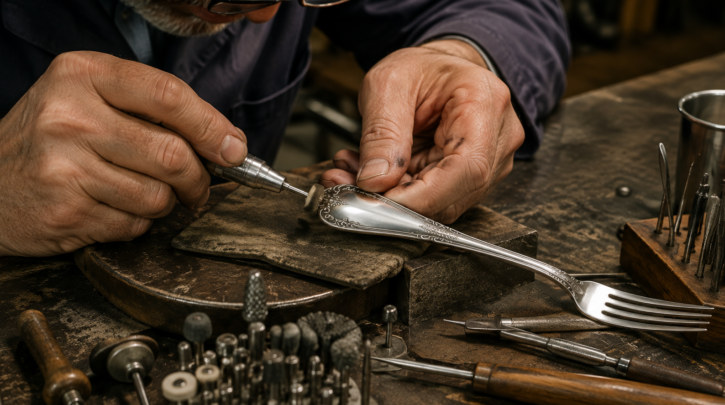
Professional monogram removal involves a silversmith carefully grinding and polishing down the engraved area until the letters are gone, which genuinely removes a small amount of metal at that specific spot — meaningful on flatware handles, which don’t have a lot of material thickness to spare in the first place, unlike a larger hollowware piece with more material to work with.
Why Professional Work Matters Here
A poorly done removal job can leave a visibly thin, slightly warped, or uneven spot where the monogram used to be, which is often more visually distracting than the original monogram was — worth using an experienced silversmith specifically for this work rather than a general jeweler unfamiliar with flatware specifically.
Impact on Resale Value
Monogrammed pieces generally sell for less than unmonogrammed pieces of the same pattern, simply because most buyers don’t want someone else’s initials on their table; see our value guide for how monogram condition factors into overall worth alongside pattern and rarity.
Some Monograms Matter Less Than Others
A simple single-letter monogram is generally less off-putting to buyers than an elaborate three-letter Victorian-style monogram, and in some cases a buyer whose own initial happens to match will actually see a single-letter monogram as a bonus rather than a drawback — worth keeping in mind before assuming every monogram needs to be removed.
Embracing a Monogram Is a Legitimate Choice
Not every monogrammed piece needs to be “fixed” — a monogram tied to genuine family history carries real sentimental value, and keeping a set exactly as it was originally engraved is a completely reasonable choice for anyone planning to keep and use the set themselves rather than sell it.
Re-Monogramming for a New Owner
Some buyers of unmonogrammed antique flatware choose to have it professionally engraved afterward with their own initials, which is a real, common service offered alongside removal — worth knowing this option exists whether you’re removing an old monogram or adding a new one.
Weighing the Cost
Professional monogram removal is a genuine expense, and it’s worth weighing that cost against how much value it actually adds — for a common, modestly valued pattern, removal costs can meaningfully exceed the value gained, while for a rarer or more valuable pattern, removal is more likely to be worth the investment.
A Reasonable Decision Process
Identifying the pattern and getting a realistic sense of the set’s value first, then deciding whether removal, keeping the monogram, or simply accepting a lower resale price makes the most sense for your specific situation, beats making the decision before understanding what the set is actually worth either way; see our appraisal guide for how to get that realistic value assessment.
Monograms and Genuine Family History
Beyond pure resale calculations, a monogram sometimes carries real documented family history — knowing exactly whose initials appear on a set and how it moved through a family over generations adds a dimension of value that has nothing to do with the open market and everything to do with the specific story a piece can tell.
Checking Monogram Style for Dating Clues
The style of an engraved monogram — ornate Victorian script versus a simpler, more restrained mid-century block letter style, for instance — can sometimes offer a rough supporting clue about roughly when a piece was originally engraved, useful alongside pattern and mark research when trying to date a set with genuine uncertainty.
Discussing the Decision With Family
For a set with genuine sentimental significance shared across a family, discussing whether to remove or keep a monogram with other family members who might have their own attachment to the piece avoids the disappointment of an irreversible removal decision made unilaterally on something that mattered to more than just one person.
A brief family conversation costs little and can prevent real regret over an irreversible decision made too quickly.