
Deciding what a “complete” flatware set actually means for your own situation matters more than chasing an arbitrary checklist, though understanding the standard components gives a useful starting framework before deciding what you personally need.
The Basic Place Setting
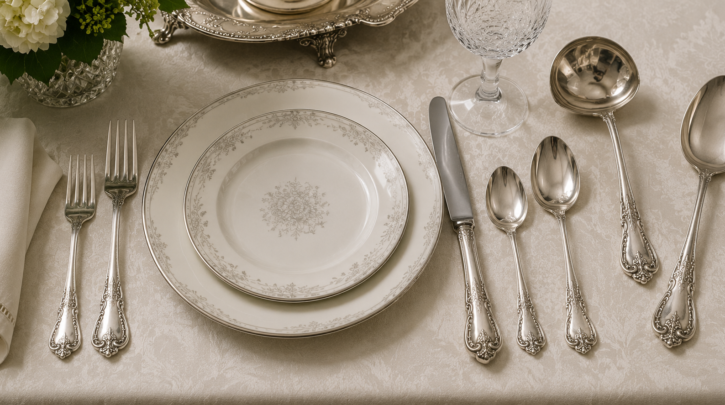
A standard place setting typically includes a dinner fork, salad fork, dinner knife, and teaspoon, sometimes with a soup spoon added, and “service for eight” or “service for twelve” describes how many complete place settings a set includes; see our matching guide for how this counting convention works when shopping for replacement pieces.
Common Serving Pieces
Beyond basic place settings, a formal service typically adds serving pieces sold and counted separately: a gravy ladle, a pie or cake server, solid and pierced serving spoons, a cold meat fork, a sugar spoon, and a butter knife are among the most common specialty pieces collectors and sellers reference when discussing a “complete” formal service.
Building From Scratch vs. Completing an Inherited Set
Starting a collection from nothing and completing an inherited partial set both rely on the same matching principles, though an inherited set has the advantage of already establishing the exact pattern and maker you’re working with, narrowing the search considerably compared to choosing a pattern from scratch; see our pattern identification guide for confirming exactly what an inherited set actually is before deciding what to add.
Deciding What ‘Complete’ Means for You
Not everyone needs or wants a full formal service with every specialty serving piece — someone planning mostly everyday, casual use might reasonably stop at basic place settings plus a couple of serving spoons, while someone who regularly hosts formal dinners might genuinely want the full traditional lineup. Deciding what fits your actual use case is a legitimate personal choice, not a checklist everyone needs to complete identically.
Prioritizing What to Complete First
For a large gap in an inherited or partially built set, prioritizing the most functionally important pieces first — dinner forks and knives before less frequently used specialty serving pieces — makes a large completion project feel more manageable and gets the set to genuinely usable sooner.
Mixing Place Sizes Within a Set
Because many patterns were produced in both larger “dinner size” and smaller “place size” versions, confirming which size an existing set uses before adding more pieces avoids an inconsistent look across a table setting, even when the pattern and maker match exactly; see our matching guide for this specific sizing consideration.
Start With the Basics
Before deciding how far to build out a set, our free 5-Second Sterling vs. Silverplate ID Checklist confirms exactly what you’re working with.
A Reasonable Long-Term Approach
Treating set completion as an ongoing, unhurried project — adding pieces as they turn up at a fair price rather than rushing to complete everything at once — keeps the process enjoyable and financially sensible, especially for rarer or retired patterns where patience genuinely pays off; see our active vs. retired patterns guide for why some completion projects reasonably take years.
Serving Pieces Worth Prioritizing
Among the various specialty serving pieces, a general serving spoon and a gravy ladle tend to see the most regular use for most households, making them reasonable priorities to acquire before less frequently needed items like a specific cold meat fork or an elaborate pie server reserved for occasional formal entertaining.
A Set That Genuinely Fits Your Life
The most successful flatware collections tend to be the ones built around how a person actually eats and entertains, rather than an idealized standard borrowed from a bridal registry checklist or an old etiquette guide — a smaller, genuinely used set often brings more satisfaction than a technically complete one that mostly sits in a drawer.
Revisiting the Question Over Time
What counts as complete can genuinely change as your life changes — a set that felt sufficient for a small household might feel incomplete once regular entertaining becomes part of your routine, and there’s nothing wrong with revisiting and expanding a completion goal years after first settling on it.
A flatware collection, like most good collections, is meant to serve you rather than the other way around.