
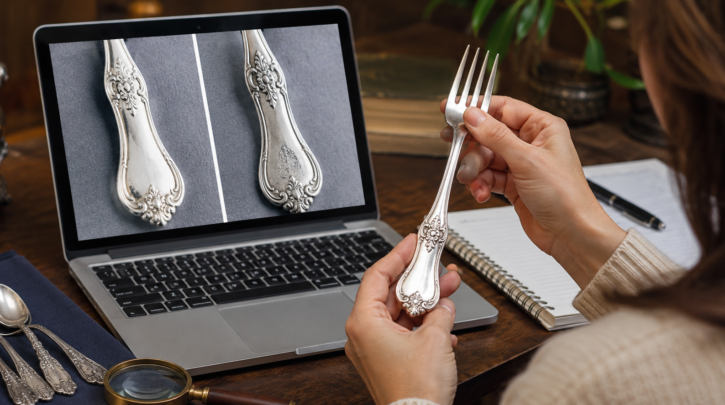

Identifying a flatware pattern is a genuinely different challenge than identifying most other collectibles — with thousands of distinct patterns produced across dozens of manufacturers over more than 150 years, and pattern names almost never stamped on the piece itself, matching what you’re holding to a specific name is almost entirely a visual exercise.
Start With the Maker
Identifying the maker first, through the mark stamped on the piece, dramatically narrows the search — rather than comparing your piece against thousands of patterns from every manufacturer, you’re now only checking one company’s own catalog of patterns; see our marks and hallmarks guide for how to read a maker’s mark reliably.
Note the Key Visual Elements
Once you know the maker, focus on the pattern’s distinguishing features: the general style of ornament (floral, scrollwork, geometric, figural), how densely the design covers the handle, and the overall handle silhouette, since some patterns are distinguished more by shape than by surface decoration alone.
Check for a Rare On-Piece Number
A small number of pieces carry an internal pattern or model number stamped alongside the maker’s mark, though this is the exception rather than the rule; see our pattern numbers guide for how these internal coding systems work and where they typically show up instead of on the piece itself.
Use a Dedicated Pattern Search Tool
Replacements, Ltd. maintains one of the largest visual pattern search tools in the industry, letting you search by maker and visually compare candidate patterns against your piece — genuinely the standard starting point for identification when a pattern isn’t immediately recognizable by sight.
Try the visual pattern search tool Search for your pattern at Replacements, Ltd.
Taking a Good Identification Photo
A clear, well-lit photo of both the front and back of a single fork or spoon, along with a close-up of the maker’s mark and a ruler or coin included for scale, gives the most useful reference whether you’re comparing against an online tool yourself or submitting the piece for expert identification.
When a Pattern Search Tool Comes Up Empty
Some replacement services, including Replacements, offer free identification help from human researchers when a visual search tool doesn’t return a confident match — genuinely worth using for an unusual or obscure pattern before assuming it simply can’t be identified.
Confirm What You Actually Have First
Before diving into pattern matching, our free 5-Second Sterling vs. Silverplate ID Checklist confirms whether you’re even looking at sterling in the first place.
Active vs. Retired Patterns Matter for Next Steps
Once identified, knowing whether a pattern is still in current production or has been discontinued shapes everything about how you’d go about adding to a set; see our active vs. retired patterns guide for why this distinction matters so much for anyone trying to complete or expand a service.
Building Pattern Recognition Over Time
Repeated exposure to genuine patterns — through a collector community, reference books, or simply handling pieces over time — gradually builds the same kind of visual pattern recognition that experienced dealers rely on to identify common patterns almost instantly, without needing to run every piece through a search tool.
Where Flatware Turns Up for Identification
Estate sales, inherited kitchen chests, and antique malls remain the most common places flatware surfaces, and because so much of it was genuinely used as everyday and special-occasion tableware, unidentified pieces show up far more often in general circulation than in specialty shops alone; see our buying guide for what to expect across different sourcing options.
A Realistic First Attempt
For a first identification attempt, working through a single representative piece — ideally a spoon or fork with a clear, undamaged mark — rather than trying to identify every piece in a large inherited set individually gives you the maker and pattern needed to make quick work of the rest, since an entire matching set shares the same identification.
When a Set Actually Contains Multiple Patterns
It’s worth checking a handful of pieces rather than assuming uniformity across an entire inherited chest, since sets sometimes accumulated pieces from more than one pattern over the years, particularly gifted or replacement pieces added later that may not perfectly match the original purchase.
A quick check of a few different pieces upfront catches this before it causes confusion later in the identification process.