
Reading the marks stamped into the back of a piece of flatware is the fastest, most reliable way to confirm sterling silver, identify the maker, and sometimes narrow down roughly when a piece was made — and the marking conventions differ meaningfully between American and British silver.
The American Standard: STERLING and 925
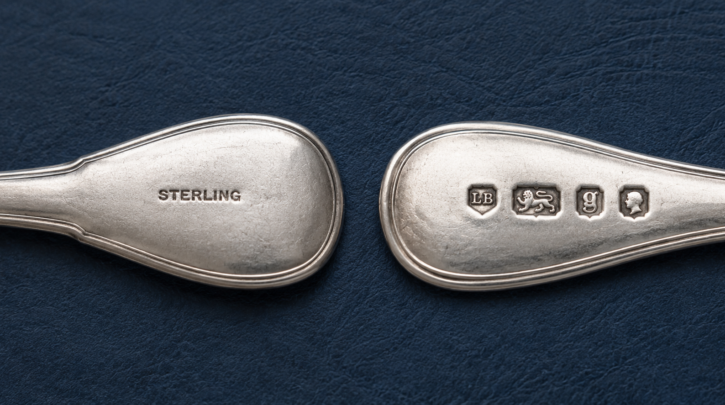
American sterling flatware is typically marked with the word “STERLING” stamped directly into the metal, and increasingly also with “925,” the numeric purity standard expressed as parts per thousand. Either mark, or both together, reliably confirms genuine sterling silver content on an American piece.
Maker’s Marks
Alongside the sterling designation, most manufacturers stamped their own distinctive maker’s mark or touchmark — a logo, symbol, or stylized name unique to that company — which helps identify who actually produced a given piece; see our Gorham guide and other maker-specific guides on this site for examples of how individual manufacturers’ marks looked.
Pattern Names Are Rarely Stamped
Unlike the maker’s mark and sterling designation, the pattern name itself is only rarely included in the stamping — most pieces require visual pattern matching against a reference rather than reading the pattern name directly off the piece; see our pattern identification guide for how that visual matching process actually works.
Coin Silver Marks
Older American silver predating widespread sterling adoption sometimes carries “COIN” or “PURE COIN” marks instead, reflecting the roughly 90% purity standard common before sterling became the dominant benchmark — a genuine historical marking worth recognizing rather than assuming represents an error or a lesser standard.
British Hallmarks: A More Elaborate System
British sterling silver uses a considerably more elaborate hallmark system than the simple American “STERLING” stamp — typically including a lion passant mark confirming the sterling standard, a town mark showing which assay office tested the piece, a date letter indicating the year of manufacture, and a maker’s mark, all stamped together in a small cluster. This system is detailed enough to deserve its own dedicated deep dive rather than a brief summary, but it’s worth knowing this more elaborate marking exists if you encounter British silver alongside American pieces.
What Marks Can’t Tell You
A genuine sterling mark confirms silver content and purity, but it doesn’t by itself confirm which specific pattern you’re holding, how rare that pattern is, or exactly what era a piece dates to beyond a rough sense tied to the maker’s own operating history; see our value guide for the other factors that determine what a specific piece is actually worth.
Checking for Altered or Fake Marks
Because a genuine sterling mark carries real financial weight, some pieces have fake or added marks meant to deceive buyers into paying sterling prices for silverplate or base metal; see our fakes and alterations guide for how to tell a genuine factory-stamped mark from one added later.
A Practical Reading Order
- Check for STERLING or 925 first to confirm silver content
- Look for a maker’s mark to identify the manufacturer
- Note any absence of a pattern name, which is normal and expected
- Compare the overall mark style against known genuine examples if anything looks unusual
Marks as Part of a Bigger Picture
A mark is the fastest single check available, but it works best combined with weight, casting quality, and pattern recognition rather than treated as a complete answer on its own — exactly the same layered approach that pays off across every collectible category.
Stamping Location Varies by Piece Type
Marks typically appear on the back of the handle for forks and spoons, and on the base of the handle for knives, near where the handle meets the blade — knowing roughly where to look on each piece type saves time when working through a large, mixed set.
Documenting Marks as You Go
Photographing each distinct mark clearly, especially when working through a large inherited set with pieces from multiple makers or eras, creates a useful reference for cross-checking later and for sharing with a collector community or appraiser if questions come up.
A little organization up front makes a large mixed set much easier to work through methodically.