
Genuine sterling carries real melt value tied to the silver market, which is exactly why two specific alterations show up repeatedly in this hobby — and why both are worth understanding before buying anything where the price assumes an intact, original piece. Unlike a mismatched mark or an assembled set, these two alterations can hit a piece that’s genuinely sterling, genuinely the right pattern, and genuinely from the right maker. They just aren’t structurally what they appear to be — and both leave physical evidence you can actually check.
The Two Alterations Worth Knowing
Monogram removal and splicing are the two alteration types that most directly affect flatware specifically, as opposed to silver collectibles generally. Both are common enough to expect in any large lot of vintage sterling, and both are detectable with a close look and a comparison piece — no lab equipment required.
Monogram Removal: Buffing Off Value
A huge share of vintage sterling flatware was originally monogrammed, and a huge share of that has since had the monogram removed to make it more sellable. The removal process — grinding or buffing down the engraved surface until the lettering is gone — necessarily thins the silver at that exact spot, since there’s no way to erase an engraving without taking metal off the surface around it.
That thinning is what makes it checkable. Compare the wall thickness and weight of the piece against an unaltered example in the same pattern and piece type: a spot where a monogram was removed will typically feel measurably thinner, sometimes with a subtle dip, warping, or softened pattern detail where the buffing wheel worked past the engraving into the surrounding design. Tilting the piece under strong light often reveals a faint shadow or texture change at the removal site even when it’s not visible head-on. See our monogrammed flatware guide for what a careful, professional removal job looks like versus a rushed one — the difference in how much silver was taken off is often the difference in how much value was lost.
Splicing: A Broken Piece Re-Soldered
The second alteration is structural: a piece that broke — often at the neck of a fork or a thin point along a knife — and was repaired by soldering the pieces back together. Done well, a splice can be visually subtle. It’s never structurally invisible, though, and it never fully restores the piece’s integrity or its value.
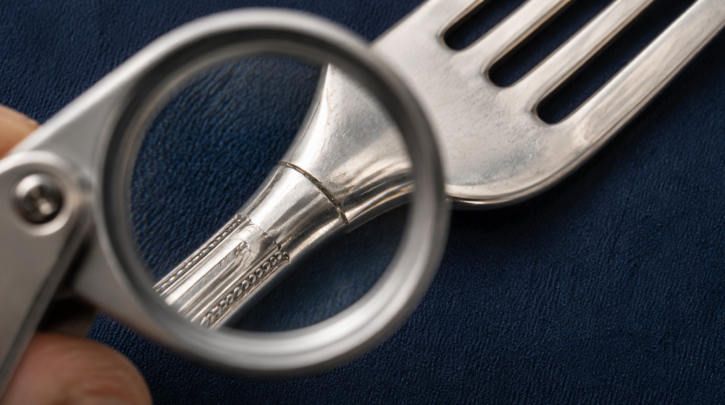
Check any suspect joint under magnification for a solder seam: a thin line of slightly different color or texture than the surrounding silver, a subtle misalignment where the two pieces don’t sit perfectly true, or a difference in tarnish pattern right at the joint compared to the rest of the piece. Solder doesn’t tarnish identically to sterling, so a seam that looks slightly duller or brighter than its surroundings after the rest of the piece has aged is a real tell. A gentle flex test — light pressure, never force — can also reveal a joint that isn’t as rigid as the surrounding metal. Weight can run slightly off too, since a solder repair adds a small amount of foreign material at the joint.
Why These Two Matter More Than Marks Alone
Checking the hallmark, as covered in our sterling vs. silverplate guide, confirms composition — but it won’t catch either of these two alterations, since a spliced or de-monogrammed piece can carry a perfectly genuine, perfectly legible sterling mark. That’s exactly why they’re worth checking separately, even on a piece that’s already passed the mark test. Fake marks stamped onto silverplate and “marriage” sets combining mismatched pieces are still worth watching for too — our value guide covers why a genuinely complete, unaltered set commands a real premium over any of these — but monogram removal and splicing are the two that slip past a mark-only check.
How to Physically Check a Piece
- Compare weight and wall thickness against a known-unaltered piece in the same pattern and form
- Run a finger slowly over any flat engraving-sized area, feeling for a dip or thinning
- Tilt the piece under strong light to catch shadow or texture changes at a former monogram site
- Inspect narrow points — fork necks, knife shoulders — under magnification for a solder seam
- Compare tarnish pattern at any suspect joint against the rest of the piece
- Apply gentle flex pressure to a suspect joint; genuine one-piece construction won’t give
Run the Quick Checks Before You Buy
Our free checklist covers the fastest sterling authentication tells, sized to actually use while you’re examining a piece before a purchase.
Being Skeptical of Too-Good-to-Be-True Prices
A full sterling service priced dramatically below what its silver weight alone would suggest deserves real scrutiny before purchase — either the seller is unaware of genuine value and offering a real bargain, or something about the claimed condition (an unusual number of spliced or de-monogrammed pieces, for instance) doesn’t hold up, and it’s worth confirming which before assuming the former.
Buying From Reputable Sources
Buying from established dealers with a track record in sterling silver specifically, or through a service like Replacements, Ltd. that evaluates pieces as part of its own buying process, meaningfully reduces risk compared to an anonymous listing with no reputation history behind it, particularly for a significant purchase.
When in Doubt, Get a Second Opinion
For any purchase where the price assumes genuine, unaltered sterling at meaningful weight, getting a second opinion from an experienced dealer — or a professional appraisal for anything substantial — before committing is worth the extra effort. The cost of verification is almost always smaller than the cost of being wrong.
Building a Personal Reference
Photographing verified genuine marks, weights, and unaltered joints you’ve handled or purchased builds a personal reference that becomes genuinely useful whenever a new piece raises a question — the same approach that pays off across every collectible category covered on this site.
A Final Word on Due Diligence
None of these individual checks is foolproof on its own, but running through marks, weight, wall thickness, and joint condition together on any purchase where sterling content and structural integrity meaningfully affect price catches the overwhelming majority of altered pieces before any money changes hands. Slowing down for these checks costs a few minutes and can save real money on the wrong purchase.