
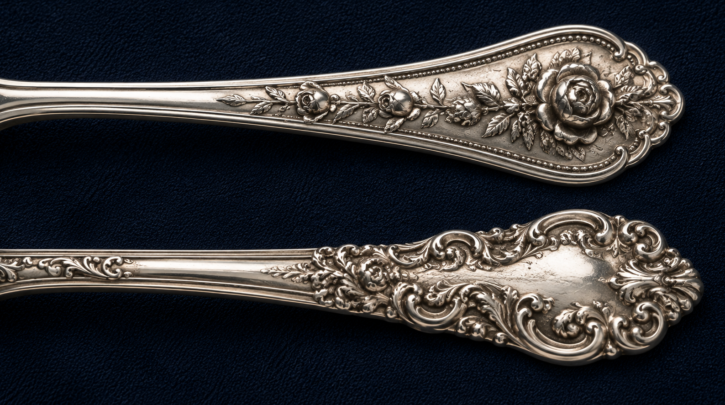

Towle and Wallace, two historic New England silver manufacturers, each built strong reputations around elaborate, richly ornamented sterling patterns that remain among the most recognized designs in American flatware history.
Towle: A Newburyport, Massachusetts Tradition
Towle Silversmiths, based in Newburyport, Massachusetts, developed a reputation for substantial, ornate relief work across its sterling flatware lines, producing patterns that lean toward dense, Renaissance-inspired ornament; see our sterling patterns guide for Old Master and King Richard, two of Towle’s most recognized patterns.
Old Colonial and Towle’s Broader Catalog
Beyond Old Master and King Richard, Towle produced a wide range of additional patterns over its history, including Old Colonial, reflecting a consistent house preference for substantial, detailed ornamentation across the company’s overall catalog.
Wallace: A Connecticut Silver Company
R. Wallace & Sons, based in Connecticut, built its own strong reputation around ornate, baroque-influenced design work, most famously through Grande Baroque; see our sterling patterns guide for more on this 1941 pattern’s elaborate scrollwork design.
Rose Point: Wallace’s Other Iconic Pattern
Alongside Grande Baroque, Wallace’s Rose Point pattern is among the company’s most recognized and sought-after designs, featuring an elaborate rose-themed motif that remains a genuine favorite among collectors specifically drawn to romantic, floral sterling designs.
Comparing the Two Companies’ Design Approaches
Both Towle and Wallace favored dense, elaborate ornamentation over the simpler, more restrained patterns some other makers produced, which makes pieces from either company a natural fit for collectors specifically drawn to the more ornate end of American sterling design, as opposed to the cleaner mid-century styles some competing manufacturers leaned toward.
Both Companies’ Broader Product Lines
Like the other major makers covered on this site, both Towle and Wallace produced substantial silverplate lines alongside their sterling flatware, following the same general dual-market approach common across the industry; see our silverplate identification guide for how to distinguish either company’s plate lines from its sterling.
Finding Towle and Wallace Pieces
Given both companies’ long production histories and genuinely popular patterns, Towle and Wallace pieces turn up regularly on the secondary market, making either company’s ornate patterns a realistic goal for a collector specifically drawn to that denser, more elaborate design style.
Search Towle and Wallace patterns to complete a set Search patterns at Replacements, Ltd.
A Shared New England Legacy
Though based in different states and never formally connected, Towle and Wallace together represent a genuinely significant share of New England’s historic silver manufacturing output, and collectors drawn to one company’s ornate style often find themselves drawn to the other’s for the same underlying reasons.
Assessing an Inherited Towle or Wallace Set
For an inherited set from either company, checking whether it matches one of the specific well-known patterns named here — Old Master, King Richard, Grande Baroque, Rose Point — versus a less individually famous pattern from the same maker meaningfully shapes expectations around both resale value and how readily matching pieces can be found; see our pattern identification guide for confirming which specific pattern you’re actually holding.
Why Ornate Patterns Reward Careful Condition Checks
The same dense relief work that makes Towle and Wallace patterns so visually striking also makes wear more noticeable when it happens, since fine detail shows the effects of decades of polishing more visibly than a simpler pattern’s smoother surfaces would — worth inspecting closely before a significant purchase in either company’s more ornate designs.
Two Makers Worth Knowing Together
Because Towle and Wallace occupy such similar territory in American sterling design, learning to recognize one company’s general style makes it easier to appreciate what distinguishes the other, even though they were always genuinely separate, independently operated companies rather than related in any formal corporate sense.
Together, they offer a genuinely deep well of ornate sterling design for any collector drawn to that particular aesthetic.
Rounding Out a Sterling Education
Between Gorham’s flowing naturalism, Reed & Barton’s detailed relief work, and Towle and Wallace’s ornate baroque and Renaissance-inspired designs, these four makers together cover most of the visual territory a new sterling collector will encounter, making them a genuinely solid foundation before branching into less common names.