
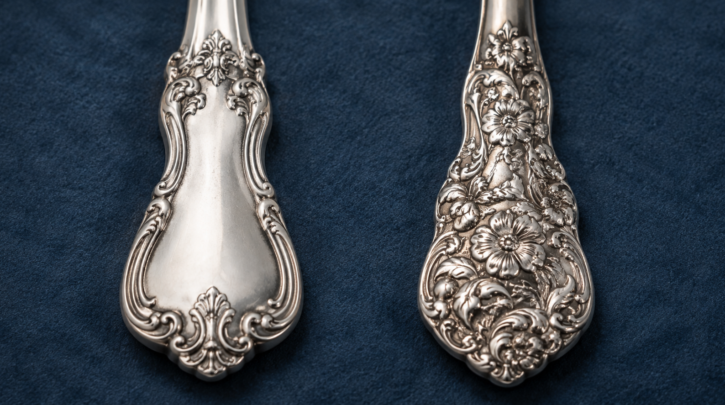

Hundreds of distinct sterling flatware patterns have been produced by American manufacturers over the past century and a half, but a much smaller core group accounts for the large majority of pieces collectors and sellers actually encounter today.
Chantilly (Gorham)
Introduced by Gorham in 1895, Chantilly is one of the most widely produced sterling patterns in American history, featuring a flowing floral scroll design, and it remained in continuous production for well over a century — a genuinely good pattern to learn first given how often it turns up in estate sales and inherited collections.
Francis I (Reed & Barton)
Reed & Barton introduced Francis I in 1907, an elaborate design featuring fruit and floral motifs across the handle, and it remains highly regarded among collectors for its detailed, richly textured relief work.
Grande Baroque (Wallace)
Wallace’s Grande Baroque, introduced in 1941, showcases an ornate baroque-inspired scrollwork design and remains one of the most recognized heavily patterned sterling designs of the mid-20th century.
Repousse (Kirk)
Kirk’s Repousse pattern, dating to 1828 by the company’s own history, is among the oldest continuously produced American sterling flatware patterns, featuring dense, hand-chased floral and scroll relief covering the entire handle — a genuinely historic design predating the widespread sterling standardization itself.
Old Master and King Richard (Towle)
Towle produced numerous well-regarded patterns over its history, including Old Master and King Richard, both featuring substantial, ornate relief work typical of the more elaborate end of American sterling design.
Range of Ornamentation
Sterling patterns span a wide range of visual complexity, from dense, heavily ornamented Victorian and Edwardian-era florals to considerably simpler, cleaner mid-century designs — worth keeping in mind that “more ornate” doesn’t automatically mean “more valuable,” since pattern popularity and rarity matter more than sheer decorative density.
How to Match a Pattern Visually
Because pattern names are rarely stamped on the piece itself, matching the handle design against a reference collection of known patterns — through a dedicated online pattern search tool or a printed reference guide — remains the standard identification method across the entire hobby; see our pattern identification guide for the general visual-matching process this requires.
Finding More of a Pattern You Own
Once a pattern is identified, finding additional pieces to complete or expand an existing set is a genuinely common need, especially for long-running patterns like Chantilly that saw production spanning multiple generations of the same family passing down a partial set.
Search for your sterling pattern to complete a set Search sterling patterns at Replacements, Ltd.
Patterns Vary Enormously in Availability
Some patterns, like Chantilly, remain genuinely easy to find given their long, high-volume production runs, while others were produced for only a short window and are considerably scarcer today; see our active vs. retired patterns guide for how production history affects how easy a specific pattern is to track down today.
Learning Patterns by Manufacturer First
Because each manufacturer’s design language tends to have a recognizable overall character — Gorham’s flowing florals, Towle’s dense Renaissance-inspired relief — getting familiar with a maker’s general style first can narrow down which reference section to check even before you’ve matched the exact pattern name.
Naming Conventions Worth Knowing
Many pattern names reference historical periods, French phrases, or aristocratic-sounding themes — Chantilly, Grande Baroque, King Richard — reflecting the aspirational marketing common to fine tableware throughout the 20th century, though the names themselves offer little help identifying a pattern visually and shouldn’t be relied on as a substitute for actually comparing the handle design.
Regional and Era-Based Trends
Broader design trends — ornate Victorian and Edwardian florals giving way to cleaner Art Deco geometry, then to the varied revival and mid-century styles of the postwar decades — can help narrow down an approximate era for an unfamiliar pattern even before a specific name match is confirmed, similar to how design language shifts help date other decorative arts categories.
Combining era-based intuition with a proper reference check gives a faster and more confident identification than either approach alone.