
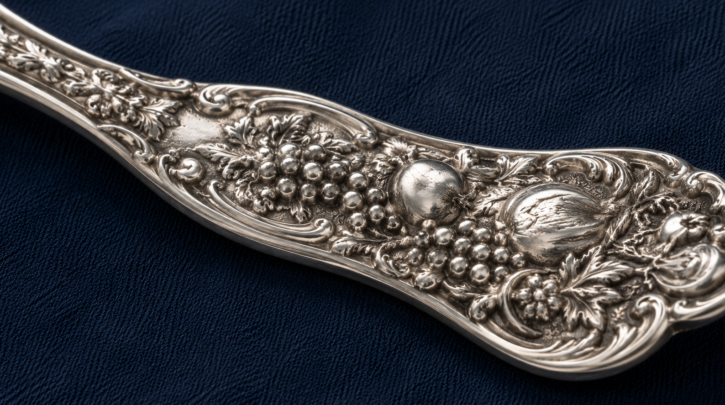

Reed & Barton, based in Taunton, Massachusetts, built its reputation on detailed, high-quality silver work, most famously through Francis I, one of the most respected and recognized sterling patterns ever produced by any American manufacturer.
A Massachusetts Silver Tradition
Taunton, Massachusetts developed into a genuine center of American silver manufacturing during the 19th century, and Reed & Barton grew out of that regional tradition into one of the industry’s most respected names, producing both sterling flatware and substantial silverplate and hollowware lines over its long operating history.
Francis I: The Company’s Signature Pattern
Introduced in 1907, Francis I features elaborate fruit and floral motifs in dense, richly textured relief across the handle, and it remains one of the most highly regarded sterling patterns in the entire hobby; see our sterling patterns guide for more on why this pattern in particular draws such consistent collector admiration.
A Reputation for Detail
Reed & Barton’s design work generally leans toward dense, highly detailed relief work rather than simpler or more restrained ornament, a house style that Francis I exemplifies about as well as any pattern from any American maker — genuinely intricate work that rewards close inspection.
Beyond Sterling Flatware
Like most major manufacturers covered on this site, Reed & Barton produced substantial silverplate lines alongside its sterling flatware, along with hollowware and giftware that extended the company’s reputation well beyond the dinner table; see our silverplate identification guide for how to distinguish the company’s plate lines from its sterling.
Later Company History
Like many historic American silver manufacturers, Reed & Barton faced real financial pressure in more recent decades as the broader silverware industry contracted, eventually being absorbed into a larger corporate structure — worth knowing this general trajectory exists even though checking a specific pattern’s exact current status directly remains the most reliable approach; see our active vs. retired patterns guide for how to do that checking.
Why Francis I Commands Real Collector Interest
Beyond its sheer visual detail, Francis I benefits from genuine, sustained collector demand built up over more than a century of production and reputation, which generally keeps both new and secondhand pieces in this pattern in active circulation; see our value guide for how a pattern’s long-term reputation like this factors into overall worth.
Finding Reed & Barton Pieces
Francis I’s popularity and long production run mean pieces turn up regularly on the secondary market, though its detailed relief work is worth inspecting closely for wear before purchase, since fine detail like this can show its age more visibly than a simpler pattern would.
Caring for Detailed Relief Patterns
Patterns with this much fine surface detail deserve particularly gentle cleaning, since aggressive polishing can wear down delicate relief work faster than it would a simpler, smoother pattern; see our cleaning guide for the gentle approach worth applying to any richly detailed pattern like Francis I.
Reed & Barton’s Broader Reputation
Beyond flatware, Reed & Barton built a genuine reputation for silver holiday and giftware items, including widely recognized annual collectible pieces, which broadened the company’s presence in American households well beyond the dinner table and gave it a recognizable name even among people who never owned a piece of its sterling flatware specifically.
Assessing an Inherited Reed & Barton Set
For anyone identifying an inherited Reed & Barton set for the first time, checking whether it’s Francis I specifically — given how much more collector attention that particular pattern draws compared to the company’s other, less individually famous patterns — is worth doing early, since it meaningfully shapes expectations around both value and how easy the pattern will be to match going forward; see our pattern identification guide for how to confirm this.
Francis I in a Modern Home
Despite its early-20th-century origins, Francis I remains a genuinely popular choice for formal table settings today, which is part of why demand for completing or expanding a set in this specific pattern has stayed consistent even as broader interest in formal silverware has softened for less individually distinctive patterns.
That sustained real-world demand is part of what keeps Francis I a genuinely sound choice for anyone starting a new sterling collection today.