
Gorham is one of the most historically significant names in American silver, founded by Jabez Gorham in Providence, Rhode Island in 1831 and growing over the following century into one of the country’s largest and most prestigious silver manufacturers, producing both sterling flatware and elaborate silver hollowware.
A Company Known for More Than Flatware
Beyond everyday tableware, Gorham built a genuine reputation for large-scale sculptural and commissioned silver work — trophies, presentation pieces, and elaborate hollowware — which gave the company a prestige that extended well beyond its flatware lines, even though flatware remains what most collectors encounter most often today.
The Gorham Mark
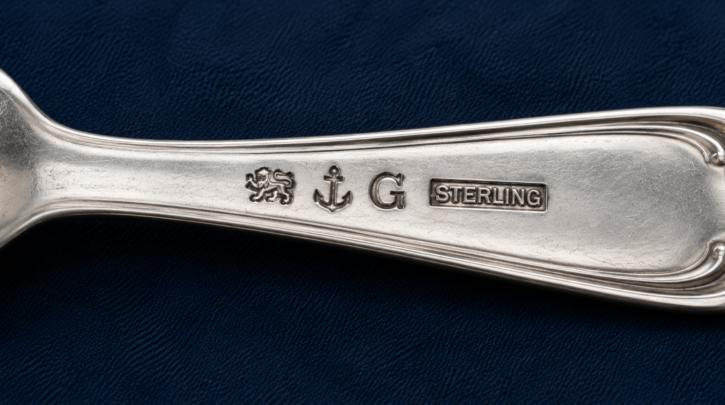
Gorham’s traditional touchmark combines a lion, an anchor, and the letter “G,” a distinctive three-symbol combination that, alongside the “STERLING” designation, reliably identifies genuine Gorham sterling; see our marks and hallmarks guide for how maker’s marks work alongside the sterling designation generally.
Chantilly: Gorham’s Most Famous Pattern
Introduced in 1895, Chantilly remains one of the most widely produced sterling patterns in American history, and it’s genuinely the pattern most associated with Gorham in the popular imagination; see our sterling patterns guide for more on Chantilly’s flowing floral design and its long production history.
Other Notable Gorham Patterns
Beyond Chantilly, Gorham produced numerous other well-regarded patterns over its long history, including Buttercup, Fairfax, and Strasbourg, each showing the company’s characteristic flowing, naturalistic approach to floral and scrollwork ornament that collectors often learn to recognize as distinctly Gorham even before checking the mark.
Gorham’s Design Language
Across its many patterns, Gorham’s design work tends toward flowing, naturalistic florals and scrollwork rather than the denser, more geometric or figural approaches some competing makers favored — a recognizable house style that develops into genuine pattern-recognition intuition with enough exposure to the company’s broader catalog.
Later Corporate History
Like most historic American silver manufacturers, Gorham went through ownership changes over the course of the 20th century as the broader silverware industry consolidated — worth knowing this history exists, even though the precise details of any single pattern’s current production status is better confirmed directly than assumed; see our active vs. retired patterns guide for how to check a specific Gorham pattern’s status today.
Finding Gorham Pieces
Given Chantilly’s enormous production volume, Gorham pieces — especially in that pattern — remain some of the most commonly found sterling on the secondary market, making Gorham a genuinely accessible starting point for a new sterling collector.
Search Gorham patterns to complete a set Search Gorham patterns at Replacements, Ltd.
A House Style Worth Learning
For anyone specifically focused on identifying Gorham pieces at a glance, spending time comparing several confirmed genuine patterns side by side builds a real feel for the company’s characteristic naturalistic flourish, which often lets an experienced eye guess Gorham correctly before ever checking the mark.
Gorham Hollowware Alongside Flatware
Because Gorham’s reputation extended so far into sculptural and hollowware silver, a genuine Gorham collection sometimes naturally expands beyond flatware into tea services, bowls, and decorative pieces carrying the same lion-anchor-G touchmark — worth keeping in mind if a broader Gorham collection interests you beyond just the dinner table.
Caring for Gorham’s Detailed Patterns
Gorham’s flowing floral relief work benefits from the same gentle cleaning approach that protects fine detail on any ornate sterling pattern, avoiding aggressive polishing that could wear down delicate surface work over repeated cleanings; see our cleaning guide for the gentle techniques worth using.
Gorham’s Place Among the Major Makers
Alongside Reed & Barton, Towle, and Wallace, Gorham rounds out the group of makers most commonly encountered in American sterling collecting — each with its own recognizable house style, but together representing the large majority of sterling flatware most collectors will actually handle over the course of building a collection.
Getting comfortable identifying all four at a glance is a genuinely achievable goal for a dedicated new collector within a reasonably short amount of time.
A Reasonable Place to Begin
Given how broadly Chantilly circulated and how consistently well-documented Gorham’s history and marks are, this maker is a genuinely reasonable place for a new sterling collector to start building both a collection and the underlying identification skills that carry over to every other maker on this site.