
Deciding whether to melt sterling flatware or sell it intact comes down to two things: how rare your pattern is, and how complete your set is. Get this decision wrong and there’s no fixing it — melting is completely irreversible, and no later discovery about a pattern’s actual rarity or history can undo it. That’s exactly why one search should always come before the furnace: look up what your pattern actually sells for on the replacement market.
The One Search That Should Come Before Any Melting Decision
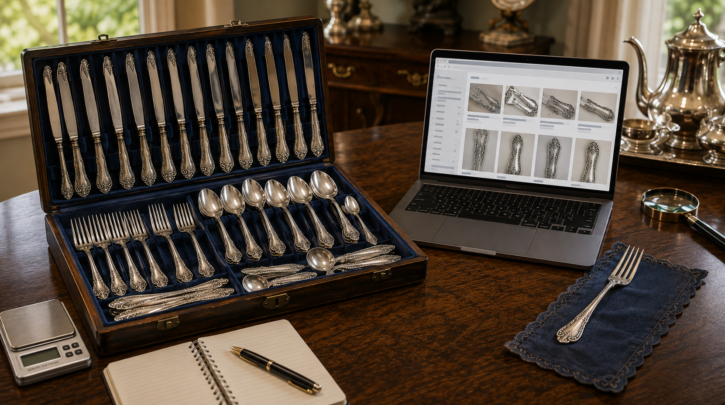
Before you melt anything, confirm the exact pattern and maker — see our pattern identification guide for that process — then search a dedicated replacement or pattern-matching service for what that specific pattern is currently selling for. This single search tells you the real number a pattern-matching buyer would actually pay, rather than a guess based on general impressions of “old silver.”
Look up your pattern’s current replacement-market price: Search patterns at Replacements, Ltd.
If that number comes back well above your calculated melt value, you have your answer already — melting anything in that pattern would be destroying value, not realizing it.
Common, Mass-Produced Patterns Rarely Beat Melt
For a common, mass-produced pattern — one that was manufactured in high volume and remains easy to find — the replacement-market price often sits close to, or even below, melt value, especially for pieces in worn condition. See our melt value guide for how to calculate that comparison figure. For this category, melting can genuinely be the more financially sensible choice.
Discontinued and Hand-Hammered Patterns Usually Beat Melt
Discontinued patterns carry a structural advantage: the supply is fixed and can only shrink, since no more will ever be manufactured. Hand-hammered patterns carry a different kind of premium — the visible tooling variation from individual craftsmanship is exactly what collectors are seeking, over and above the material value of the silver itself. Both categories routinely sell on the replacement market for well above melt value, sometimes dramatically so. See our value guide for the patterns and makers most likely to command this kind of premium.
Completeness Multiplies the Gap
A complete matched service — full place settings plus serving pieces, all in one pattern — is worth more intact than the sum of its individual piece values, because a pattern-matching buyer trying to complete their own set will pay a premium for exactly what you have. See our set completeness guide and matching guide for how that premium is typically calculated. This cuts the other way too: melting even a few pieces out of an otherwise complete service can quietly destroy the completeness premium on everything you keep, since the remaining pieces are no longer a full set to sell.
Rare Patterns Should Essentially Never Be Melted
For historically significant or genuinely rare patterns, melting essentially never makes financial sense regardless of individual piece condition, since rarity itself generally preserves meaningful collector value even on pieces that wouldn’t otherwise be considered pristine.
Check Piece by Piece, Not Just by Pattern
Even within an overall common pattern, specific serving pieces or unusual forms can be worth considerably more than melt value individually — worth reviewing a full set piece by piece before deciding to melt the whole thing based on an overall impression of the pattern’s general commonness.
A Reasonable Decision Process
- Identify the exact pattern and maker
- Search a replacement/pattern-matching service for that specific pattern’s current price
- Calculate the piece’s melt value as a comparison point
- Compare the two figures honestly, including any completeness premium for a full service
- For anything genuinely uncertain, get a professional opinion before proceeding
Confirm Composition Before Any Decision
Before running any melt-value math, our free 5-Second Sterling vs. Silverplate ID Checklist confirms you’re actually holding sterling in the first place.
When in Doubt, Don’t Melt Yet
Because melting forecloses every other option permanently, any genuine uncertainty about a pattern’s identity or value is a reason to pause and research further — or get a professional appraisal — rather than defaulting to melting simply because the process feels faster. See our appraisal guide for how that professional check works.
A Middle Path: Selling Duplicates, Keeping Standouts
For a large mixed collection, it’s worth considering a hybrid approach — melting genuinely common, low-value duplicate pieces while setting aside anything that turns out to be a rarer pattern, an unusual form, or a piece with real family significance, rather than treating the whole collection as a single all-or-nothing decision.
Emotional Decisions Deserve Extra Caution
Melting an inherited set can feel like a quick, practical way to resolve an emotionally complicated situation, but that same emotional pressure is exactly why it’s worth slowing down first — a decision made in haste during a stressful time is harder to feel good about later than one made with a clear head and accurate information.
A Realistic Timeline for This Decision
Taking a few weeks to properly identify a pattern, check its replacement-market price, and possibly get a professional opinion costs very little compared to the value of getting an irreversible decision right — there’s rarely a genuine urgency that requires melting anything immediately. Patience costs nothing here, while an irreversible mistake can cost real money and real regret.