
Silverplate marking conventions differ meaningfully from sterling’s simple, standardized “STERLING” or “925” — there was never a single mandatory purity standard for plate, which means the marks you’ll actually encounter vary more and require a bit more context to read correctly.
EPNS: Electroplated Nickel Silver
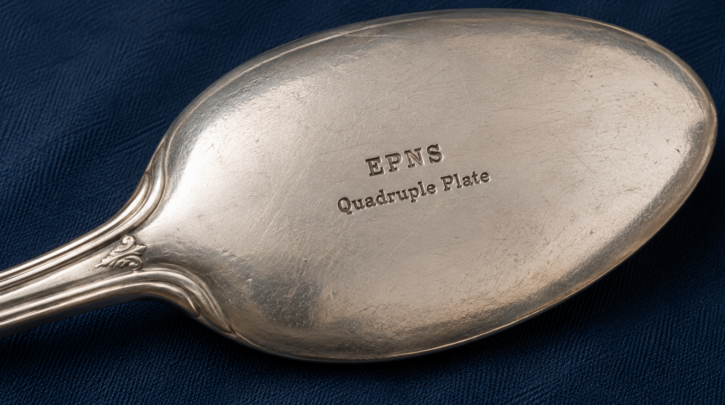
“EPNS” is probably the most common and most straightforward silverplate mark, spelling out exactly what the piece is: a nickel silver base metal with an electroplated layer of genuine silver on the surface. Seeing this mark confirms plate status immediately and reliably.
Quality Grading Marks: A1, Triple Plate, Quadruple Plate
Older silverplate sometimes carries quality grading marks — “A1,” “Triple Plate,” or “Quadruple Plate” — reflecting a historic system indicating roughly how much silver was deposited during the plating process, with quadruple plate representing a heavier silver deposit than the baseline standard. These are meaningful quality indicators within the plate category, though they still don’t approach sterling’s actual silver content.
Marks With No Purity Claim at All
Many silverplate pieces carry nothing more than a maker’s name or logo, with no fineness or grading claim whatsoever — genuinely normal for the category, since plate manufacturers weren’t bound by the same marking conventions sterling makers followed, and the absence of any purity language doesn’t itself indicate anything unusual or suspicious.
The ‘Rogers’ Name Confusion
Because the original Rogers Brothers silverplate process was so commercially successful, numerous other, entirely unrelated companies incorporated some version of “Rogers” into their own branding over the following decades, hoping to benefit from the name’s strong reputation — a genuine, well-documented source of confusion in the antiques trade that’s worth knowing about specifically, since a “Rogers”-marked piece isn’t automatically connected to the original, most historically significant company of that name.
Confirming Which ‘Rogers’ Company Made a Piece
Comparing the exact wording and logo style of a Rogers-branded mark against verified reference examples helps sort out which specific company actually produced a given piece, since the differences between the various Rogers-branded companies can be subtle at a casual glance despite representing genuinely different manufacturers with different histories and reputations.
Marks Confirm Plate, Not Pattern
Just like sterling marks, a silverplate mark confirms composition and maker but not which specific pattern you’re holding — pattern identification still requires visual matching; see our pattern identification guide for that separate process.
Why Reading Marks Carefully Still Matters
Even without sterling’s melt-value stakes, correctly reading a silverplate mark still matters for confirming maker, general quality tier, and roughly how old a piece is likely to be, all of which feed into an honest assessment of what a specific piece is actually worth; see our silverplate value guide for how these factors combine in practice.
Marks Also Appear on Serving Pieces
Larger serving pieces — trays, tea sets, serving spoons — generally carry the same marking conventions as flatware, though placement varies more by piece shape, so it’s worth checking the underside or back of any silverplate item systematically rather than assuming marks only appear in one standard location across every form.
Documenting Marks in a Mixed Collection
For a large, mixed inherited collection potentially spanning multiple makers and both sterling and plate pieces, photographing each distinct mark as you sort through the collection creates an organized reference that makes later research and any eventual appraisal conversation considerably faster.
International Silverplate Marking Differs Too
Just as sterling has its own more elaborate international hallmark traditions outside the simple American standard, silverplate marking conventions from other countries can differ from the American EPNS and grading-tier system covered here — worth keeping in mind if you encounter silverplate alongside American pieces in an inherited or purchased collection, and treating unfamiliar marks as worth researching rather than assuming they follow American conventions.
When a Mark Is Too Worn to Read
A silverplate mark can wear illegible over decades of handling just like a sterling mark can, and in that case the wear-through check, overall weight, and pattern comparison against known plate designs become the more useful identification tools; see our identification guide for how these physical checks work together when a mark alone isn’t enough.
These physical checks become especially valuable on older pieces that have simply seen the most handling over the years.