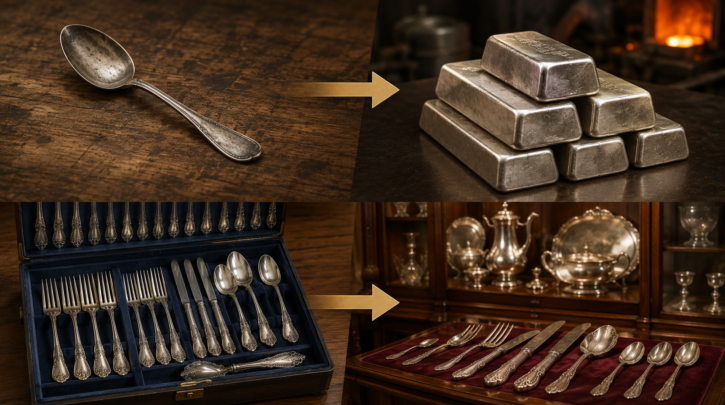

Before deciding where to sell a piece of silver flatware, decide which situation you’re actually in — because it changes everything downstream. Sterling’s floor value is protected by melt price no matter what: weight and silver content are objective facts. But a complete set, or a piece in a rare or discontinued pattern, can be worth several multiples of melt to the right collector or pattern-matching buyer. Sell the wrong piece the wrong way and you either leave real money on the table or waste weeks trying to find a collector for something that was only ever worth scrap.
The First Decision: Melt Value or Collector Value?
Every piece of sterling flatware has a melt-value floor — what it’s worth based purely on silver weight and current spot price, regardless of pattern or maker. Silverplate has essentially no melt value; the silver layer is too thin to matter. On top of that floor, collector value comes from pattern rarity, maker reputation, set completeness, and condition — and for the right piece, this number can dwarf melt value entirely. Figuring out which of these two numbers actually governs your piece, before you choose a selling channel, is the single most important decision in this whole process.
Step 1: Confirm Composition and Pattern
Confirming whether a piece is sterling or silverplate, then identifying the specific pattern and maker, is the foundation everything else builds on — a piece mispriced because it was misidentified helps no one, whether it sells for less than it’s worth or sits unsold at an unrealistic price. See our pattern identification guide and sterling vs. silverplate guide for the framework that applies across every maker and composition covered on this site.
Step 2: Check Rarity and Completeness — This Determines Which Fork You’re In
Once you know the pattern, check two things: how rare or sought-after it is, and how complete your set is. These two factors together tell you which fork you’re on.
- Rare or discontinued pattern, large or complete set: collector value likely exceeds melt significantly. See our most valuable sterling patterns guide and set completeness guide to check where your pieces land.
- Common pattern, worn condition, incomplete or mixed set: melt value is likely your realistic ceiling, and a precious metal dealer is probably your most efficient buyer.
If You’re in Melt-Value Territory
For sterling with limited collector appeal, sell for melt through a reputable precious metal dealer, and confirm they’re weighing and quoting honestly against current spot price. Our melt value guide walks through the calculation, and our melt vs. sell guide covers the handful of situations where it’s still worth double-checking for collector value before scrapping anything — a rare piece hiding inside an otherwise ordinary lot is the classic costly mistake here.
If You’re in Collector-Value Territory
Never sell a rare-pattern or complete set for melt value — that’s leaving the collector premium on the table entirely. Instead, sell to a buyer who specifically wants your pattern.
Sell your pattern through Replacements, Ltd.: Learn how Replacements buys silver flatware
For patterns and pieces better suited to a broader buyer pool, general collector marketplaces reach the largest possible audience of interested buyers.
Check current listings and completed sales for your pattern: Search sterling silver flatware on eBay
When You’re Not Sure Which Fork You’re In
For anything that seems like it could be a genuinely rare pattern, an unusual serving piece, or part of a documented significant set, a professional appraisal before setting a price is worth the cost — guessing wrong in either direction on a genuinely valuable piece has real consequences. See our appraisal guide for how that process works and when it actually pays for itself.
Clean Gently Before Photographing
A gentle clean before listing genuinely helps a piece show well in photos, but resist the urge to attempt any deeper restoration or aggressive polishing right before a sale — over-polishing silverplate specifically can accelerate wear-through. See our cleaning guide for the gentle approach worth using.
Photography That Actually Sells
Clear, well-lit photos of the maker’s mark, the pattern detail, and any monogram — disclosed honestly rather than cropped out of frame — give serious buyers the specific details they’re actually looking for, since collectors buying online rely heavily on these detail shots to confirm composition and pattern before purchasing.
Honest Condition Disclosure
Disclosing monograms, bent tines, loose knife handles, or any prior repairs clearly and specifically, rather than using vague language, protects your reputation as a seller and avoids disputes after a sale — serious buyers specifically appreciate sellers who describe condition precisely.
Writing a Listing That Builds Trust
A detailed, specific listing — exact pattern name, maker, composition, precise piece count, and an honest condition description including any monogram — consistently outperforms a vague one, since serious buyers actively search for specific patterns and skip past listings that don’t clearly identify what’s actually being sold.
Shipping Silver Safely
Silver flatware isn’t fragile the way glass is, but careful packing still matters — wrapping each piece individually to prevent scratching against other pieces, using a sturdy box with minimal empty space, and purchasing shipping insurance for anything of meaningful value all protect against loss or damage during transit.
Being Patient With Rare Patterns
A genuinely rare or historically significant pattern sometimes takes longer to find the right buyer than a common one would, simply because the pool of interested collectors is smaller — resist the urge to drop the price prematurely on something truly scarce just because it hasn’t sold in the first week or two.
Selling a Whole Collection at Once
For someone liquidating an entire inherited or accumulated collection rather than a few individual pieces, an estate sale company or a dealer offering to buy the full lot outright can be more practical than listing dozens of individual items one at a time, even though the per-piece return is typically lower than patient individual sales would bring. Either approach can work well — the right choice depends on how much time and effort you want to invest in the sale itself.