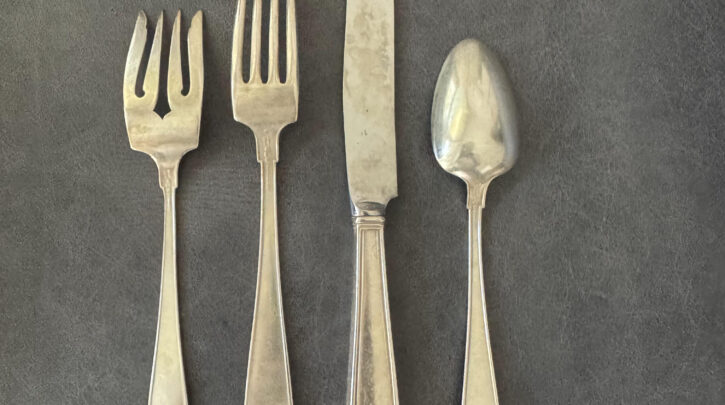

Gorham’s Etruscan and Fairfax patterns are easy to confuse. Both are sterling, both come from the early 1910s, and both have clean, geometric handles with no flowers or scrolls. A reader recently sent us photos of a family set she believed was Fairfax. One small detail on the handle, plus one line in the hallmarks, showed it was Etruscan.
Here is how to tell the two apart in under a minute.
The quick answer
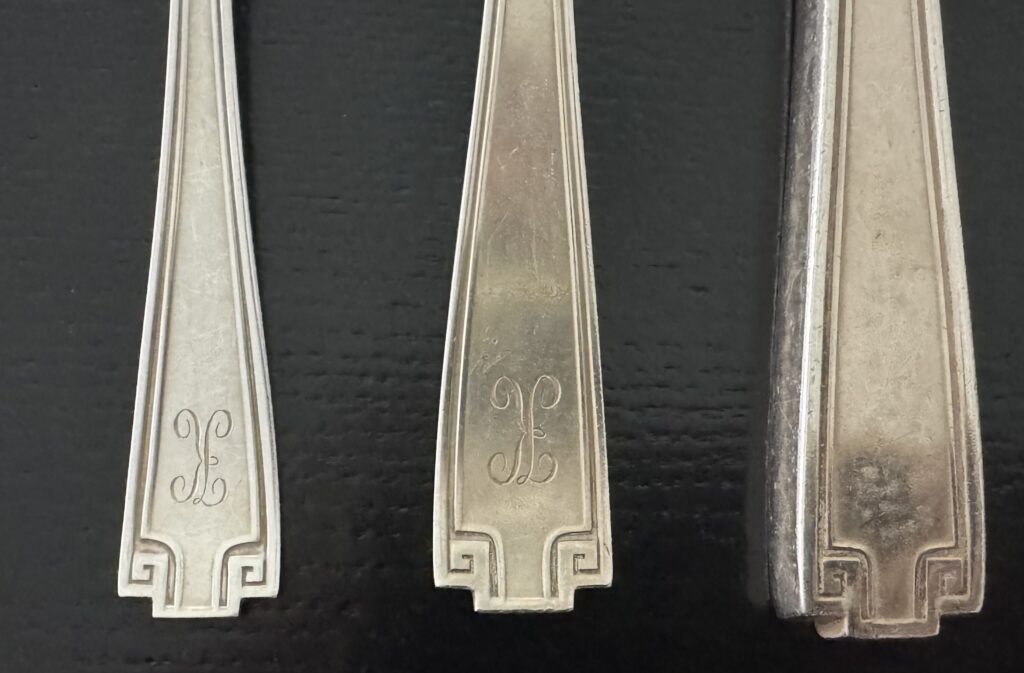
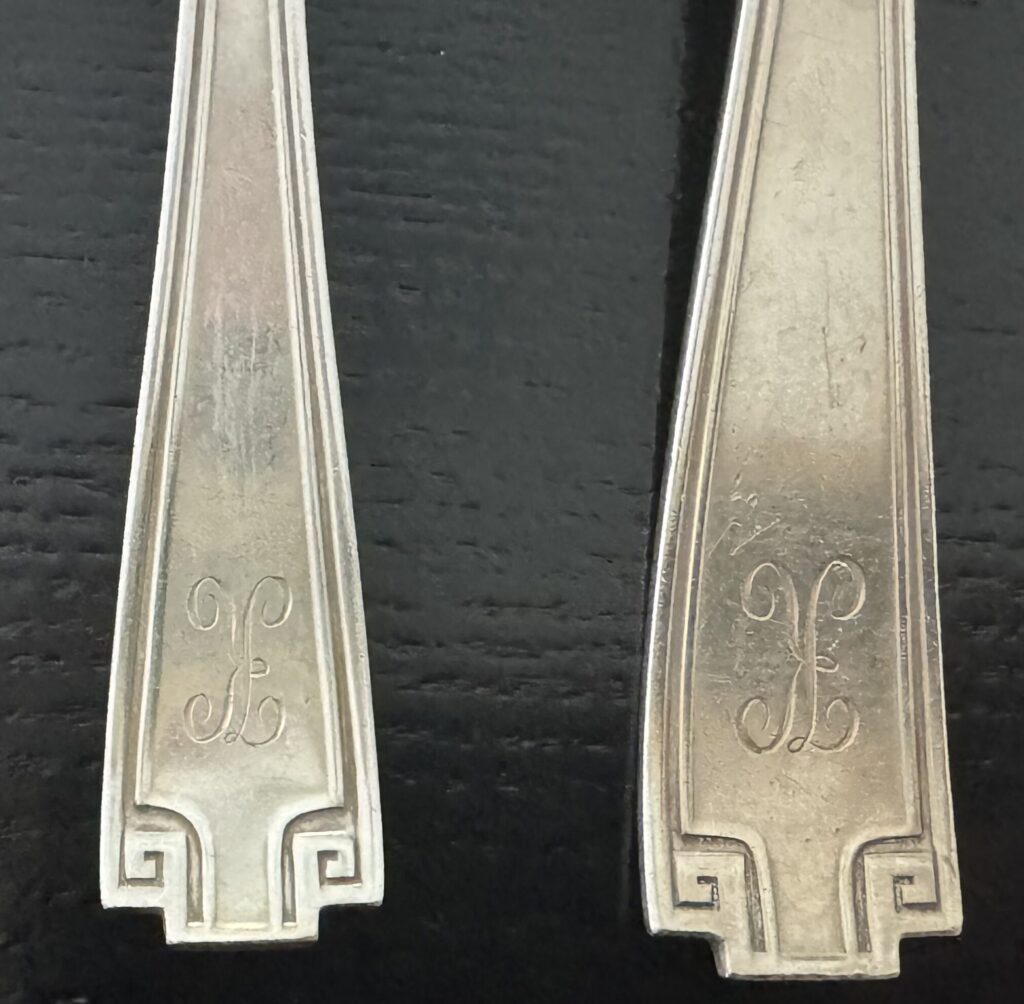
Look at the end of the handle. If you see a Greek key design (a small, squared, interlocking border), it’s Etruscan. Fairfax has crisp lines and an angled tip, but no Greek key.
Then turn the piece over. “PAT 1913” in the marks points to Etruscan, which was patented that year. Fairfax was introduced earlier, in 1910.
Etruscan at a glance
- Maker: Gorham Manufacturing Company, Providence, Rhode Island
- Introduced: 1913
- Designer: William Christmas Codman, Gorham’s chief designer
- Production: 1913 to 1991
- Signature detail: a Greek key motif at the handle tip
- Typical marks: PAT 1913, lion, anchor, G, STERLING
Fairfax at a glance
- Maker: originally William B. Durgin Company of Concord, New Hampshire, later sold as Durgin-Gorham or Gorham
- Introduced: 1910
- Style: crisp borders and angled tips inspired by the Sheraton style
- Signature detail: clean lines with no Greek key
Why the Durgin connection? Gorham bought Durgin in 1905 and kept the Durgin name in use. Durgin production moved from Concord to Providence in 1931. That’s why you’ll see Fairfax listed as Durgin, Durgin-Gorham or simply Gorham.
How to tell them apart
| Feature | Etruscan | Fairfax |
|---|---|---|
| Handle tip | Greek key design | Angled tip, no Greek key |
| Overall look | Geometric, neoclassical | Plain, Sheraton-inspired lines |
| Introduced | 1913 | 1910 |
| Original maker | Gorham | Durgin (owned by Gorham) |
| Patent date in marks | PAT 1913 | Not 1913 |
If the handle tip is worn or the photo is unclear, the patent date settles it.
Reading the marks
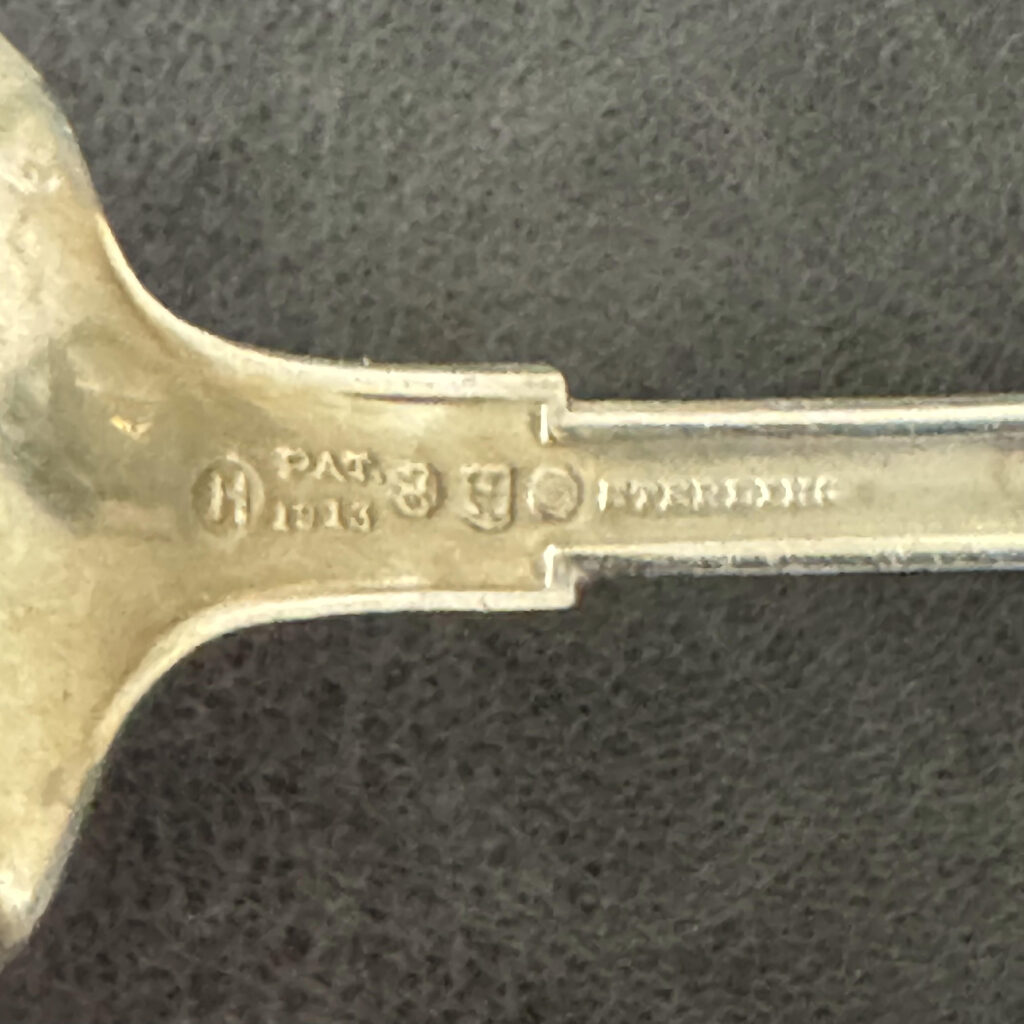
A typical Etruscan fork or spoon carries a short row of marks on the back of the handle. From left to right, our reader’s pieces showed:
- A small weight letter (T or H, more on that below)
- PAT 1913, the year the design was patented
- A lion, an anchor and a G: Gorham’s trademark
- STERLING, meaning 92.5% silver
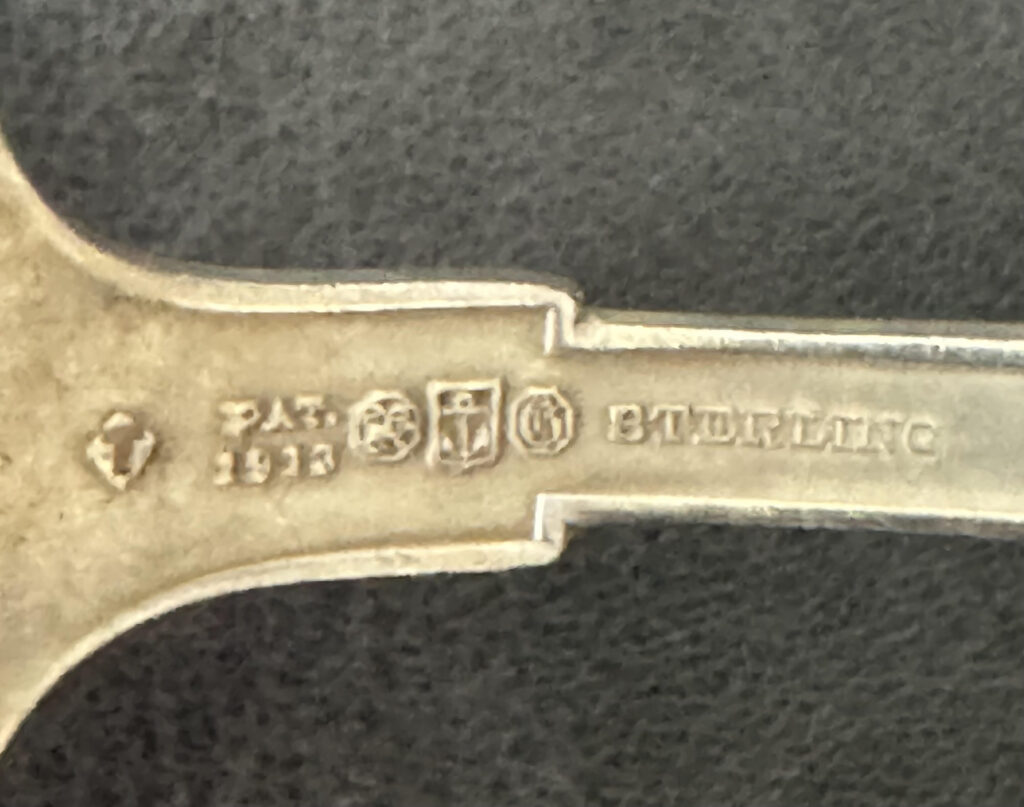
The lion, anchor and G together are the clearest sign you’re holding Gorham sterling. The anchor is a nod to Rhode Island, Gorham’s home state.
The T and H mystery
Our reader noticed a T on one piece and an H on another, and wondered what they meant. These are weight marks.
From the mid-1890s, Gorham and other large makers sold popular patterns in several weights. The same design came in thinner or thicker versions, at different prices. The letter tells you which one you have:
| Mark | Weight | Silver per dozen teaspoons |
|---|---|---|
| T | Trade (lightest) | 8 to 9 troy oz |
| H | Heavy | 14 troy oz |
Other letters exist (M for medium, E for extra heavy), and regular weight was often left unmarked. Collectors still debate a few rare letters, but T and H are well documented.
A few practical points:
- Knives don’t carry weight marks. The system applied to spoons and forks.
- Mixed weights in one set are normal. Families often built a set over years, a few pieces at a time. A T next to an H usually just means the pieces were bought separately.
- Heavy pieces hold more silver, which matters if you’re comparing prices or melt value.
Can the marks date your set?
Not precisely. Gorham didn’t date its flatware the way it dated hollowware, and Etruscan stayed in production for almost 80 years.
The weight letters do give a rough clue. The practice faded in the early 1940s and had largely ended by the mid-1940s. So an Etruscan piece with a T or H mark was most likely made before then. Treat this as a strong hint, not proof.
Family records, receipts and wedding dates are usually your best evidence for when a set was bought.
What about the monogram?
Many Etruscan pieces carry an engraved initial on the front of the handle. This was standard for wedding silver, usually the family’s surname initial. A monogram can lower resale value slightly, but it’s part of the set’s history.
Filling in a partial set
Etruscan was made for nearly 80 years, so matching pieces still turn up regularly. When buying, check the weight letter if you want new pieces to match the feel of the ones you have. A Heavy fork next to a Trade fork is noticeably different in the hand.
Want to identify more patterns?
Our Flatware Pattern Identification & Value Guide covers Gorham alongside International Silver, Reed & Barton, Wallace, Towle and Oneida, with marks, dating clues and value pointers.
Photos courtesy of Jude Bugarske Kirkeeide.
1 Comment